

The Ultimate Guide to Exploring Luxor: Egypt's Open-Air Museum
Luxor holds one-third of the world's ancient monuments. From the Valley of the Kings to Karnak Temple, here's everything you need to know before you visit.
Why Luxor Is Unlike Any Place on Earth
Standing on the east bank of the Nile in Upper Egypt, Luxor is the world's greatest open-air museum. Once known as Thebes, the ancient capital of Egypt's New Kingdom, this city of 500,000 people is surrounded by temples, tombs, and monuments that have endured for over 3,000 years. No other destination on the planet packs this density of world-class antiquities into a single city.
The East Bank: Temples of the Living
Karnak Temple Complex
Karnak is not a single temple — it's a vast religious precinct covering 100 hectares, built over 1,500 years by dozens of pharaohs. The Great Hypostyle Hall alone contains 134 massive columns, each carved with hieroglyphs and painted in vivid colours. Allow at least two hours to explore, and don't miss the Sacred Lake, where priests once performed ritual purifications. Visit at dawn when the tour buses haven't arrived yet — the golden light filtering through the columns is unforgettable.
Luxor Temple
Connected to Karnak by the Avenue of Sphinxes — a 3-kilometre processional road flanked by hundreds of sphinx statues — Luxor Temple sits in the heart of the modern city. Unlike Karnak's sprawl, Luxor Temple is compact and intimate. Visit after sunset when the temple is dramatically lit and the crowds thin out. The colossal statues of Ramesses II at the entrance are some of the most photographed images in Egypt.
The West Bank: City of the Dead
Valley of the Kings
Carved into a remote desert valley, the Valley of the Kings served as the royal burial ground for pharaohs from the 16th to 11th century BC. Over 60 tombs have been discovered here, including the famous tomb of Tutankhamun found by Howard Carter in 1922. Your standard ticket covers three tombs — choose wisely. KV9 (Ramesses VI) has the most spectacular ceiling of the entire valley, painted with the Book of the Night and the Book of the Day. KV11 (Ramesses III) is the longest tomb at over 180 metres. Tutankhamun's tomb (KV62) requires a separate ticket but is a must for its golden sarcophagus.
Temple of Hatshepsut
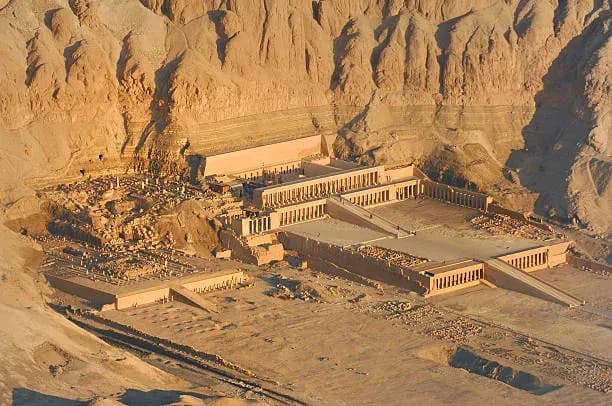
Rising in three dramatic colonnaded terraces against the sheer limestone cliffs of Deir el-Bahri, the mortuary temple of Hatshepsut is one of ancient Egypt's greatest architectural achievements. Hatshepsut was Egypt's most successful female pharaoh, ruling for over 20 years and overseeing ambitious building projects and lucrative trade expeditions. The painted reliefs inside the temple tell the story of a divine expedition to the land of Punt.
Colossi of Memnon
These two massive quartzite statues of Amenhotep III have stood sentinel at the entrance to his mortuary temple for 3,400 years. Rising 18 metres from the plain, they are the first monuments you encounter crossing to the west bank. Once surrounded by a vast temple complex (larger than Karnak), most of it now lies buried. Excavations continue to this day.
Practical Tips
- Best time to visit: October to April when temperatures are bearable (25-30°C). Avoid June-August when it regularly exceeds 45°C.
- Getting around: Hire a private driver for the west bank — it's the most efficient way to see multiple sites. Felucca rides on the Nile at sunset are magical.
- Dress code: Cover shoulders and knees at all temple sites. Light linen clothes are ideal.
- Photography: A photography permit is required inside many tombs. It's worth paying for — the painted walls are breathtaking.
- Stay: The Al Moudira is a stunning boutique hotel in a converted mansion on the west bank. Winter Palace on the east bank is a classic colonial landmark.
Day Trip vs Extended Stay
Many travellers make the mistake of treating Luxor as a day trip from Hurghada or Sharm el-Sheikh. Don't. You need at least three days to do the east bank and west bank justice without rushing. A week is ideal if you want to explore lesser-known tombs like the Valley of the Nobles and Deir el-Medina, the village of the workers who built the royal tombs.
Luxor rewards slow travel. The more time you invest, the more layers reveal themselves — history piled upon history, each dynasty adding to the one before. There is nowhere else like it on earth.